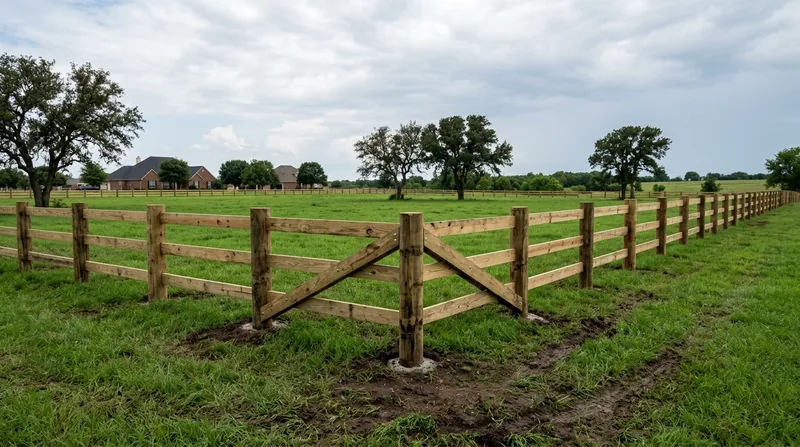




Plano and the surrounding Collin County landscape offer acreage and working properties that demand serious farm fence installation in Plano to contain livestock, define property lines, and withstand the seasonal stresses of North Texas weather. The gently rolling Blackland Prairie terrain, with its deep expansive clay soil and mature post oak and cedar elm stands, presents real challenges for long-run fencing: posts must be set deep and true to handle spring swelling and summer drought cycles, and braced corners hold their integrity through the severe weather season that builds from March through June. Whether you manage horses, cattle, or simply want to secure a multi-acre property, ranch fence installation requires the right materials, proper spacing, and experienced crews who understand local soil conditions and can run straight lines over uneven ground. Plano Fence Company has installed and repaired working fences since 2015, and we bring field knowledge, not just labor, to every project across Greater Plano and into McKinney, Frisco, Allen, and surrounding counties. We are fully insured and an AFA Member Installer, and we work from your survey to install on the line you identify, ensuring your investment protects your property and livestock for years to come.
Why Farm & Ranch Fencing Matters on Plano Acreage
Acreage in and around Plano sits on land that swells and cracks with seasonal moisture extremes. A fence that is not set properly or braced for corner stress will rack (twist out of square) or settle unevenly as the soil moves beneath the posts. Livestock containment demands a barrier that will not fail, and property definition requires a line that stays true. Long runs across open pasture also face wind load from North Texas thunderstorms, particularly during spring severe weather when supercells produce large hail and straight-line wind.
- Posts set in concrete below the frost line hold their depth and plumb through seasonal clay expansion and contraction.
- Braced corners and anti-sag bracing on long runs prevent racking and keep rails parallel under wind and animal pressure.
- Proper post spacing, typically 6 to 8 feet for rail fencing and 4 to 6 feet for field wire, distributes load evenly and reduces the chance of a single weak point.
- Gates sized for trailers and equipment, hung on heavy-duty hinges and fitted with self-closing hardware, move freely and close reliably.
A well-built ranch fence protects your investment and saves time and money by keeping livestock secure and reducing the need for constant repair.
Key info: Plano and McKinney properties on acreage often sit on soil that expands significantly after spring rain. Posts installed only 2 to 3 feet deep will heave and settle, leaving gaps and misaligned rails. We set posts 3 to 4 feet deep in concrete to anchor them through the seasonal cycle.
How We Install Farm & Ranch Fencing in Plano: The Process
Our approach starts with a clear line and ends with a fence that will last. We use a transit or string line to mark your fence run, verify it against your survey, and then mark post locations before any digging begins. Once posts are located, we call for a utility locate through Texas 811 to ensure we avoid buried lines. After utilities are marked, we dig post holes to the depth required by soil type and frost conditions, set posts in concrete, and allow the concrete to cure before we attach rails, boards, or field wire.
- We mark the fence line using your existing survey and confirm the layout with you before we break ground.
- We call Texas 811 for a utility locate and wait for utilities to be marked before digging any post holes.
- We dig post holes to the depth required by local soil conditions, typically 3 to 4 feet for ranch fencing on Plano acreage.
- We set posts in concrete, ensure they are plumb, and allow the concrete to cure for at least 24 hours before attaching any materials.
- We install rails, boards, or field wire, brace corners, and hang gates on heavy-duty hinges with self-closing hardware.
This methodical approach ensures your fence runs true, posts stay anchored, and gates operate smoothly through years of use and seasonal weather.
Example: A 10-acre property near Willow Bend in Plano required 600 linear feet of no-climb horse fence with three gates. We located the line using the owner's survey, called 811, dug 75 post holes 4 feet deep in concrete, installed 2x4 rails with anti-sag bracing at the corners, and hung gates with self-closing hardware. Total time on-site was four days, and the fence has held square through two North Texas severe-weather seasons.
Farm & Ranch Fencing Methods and Materials
| Approach | Description | Best for |
|---|---|---|
| Split Rail Fence | Pressure-treated or cedar rails mortised into posts, typically 3 or 4 rails high, no boards or wire between rails. | Property definition, decorative appeal, and moderate containment on pasture where small livestock are not a concern. |
| No-Climb Horse Fence | Rigid welded wire or woven mesh panel, typically 1.5 to 2 inches square, mounted on 2x4 or 2x6 pressure-treated rails with anti-sag bracing. | Horses, donkeys, and other large livestock where climbing or reaching through gaps is a safety risk. |
| Pipe Fence | Steel pipe, typically 2 to 2.5 inches diameter, welded or bolted to steel posts, galvanized or powder-coated for rust resistance. | High-value livestock, arena perimeters, and properties where durability and low maintenance take priority over cost. |
| Barbed Wire Fence | Typically 4 to 5 strands of barbed wire on pressure-treated posts and cross-braced corners, often combined with a top rail for visibility. | Cattle ranches and large pastures where cost per linear foot is critical and livestock are accustomed to wire fencing. |
| Field Wire Fence | Woven field wire, typically 4 to 6 feet tall, stapled to pressure-treated posts, sometimes topped with one or two strands of barbed wire. | Sheep, goats, and mixed livestock where a physical barrier prevents jumping and climbing without the cost of rigid panels. |
Each method balances cost, durability, and the specific needs of your livestock and terrain. We help you choose the right approach for your acreage, soil, and animals.
Farm & Ranch Fencing Cost in Plano: What to Expect
Farm and ranch fencing across Plano and surrounding acreage typically starts at $12 per linear foot for basic split rail or field wire installations on straightforward terrain. The final cost depends on several real factors: whether the land is level or slopes, how many trees or obstacles require post placement adjustments, the type of material you choose (pressure-treated wood, welded wire panels, or steel pipe), the depth posts must be set to account for Plano's expansive clay soil, and whether gates and braced corners are needed. A no-climb horse fence with anti-sag bracing runs higher than simple split rail because the materials and labor are more substantial. Pipe fencing carries the highest cost per foot but offers decades of life with minimal maintenance.
We recommend getting 2 to 3 estimates from contractors who will visit your property, measure the run, identify obstacles, and account for local soil conditions. A phone quote is a guess; an on-site look is the only way to know what the job will actually cost. Visit our pricing page for detailed breakdowns by material and method, and call us at (940) 326-4616 for a free estimate.
Farm & Ranch Fencing Near Me: What Plano Homeowners Should Know When Hiring
Hiring the right contractor for ranch fencing means checking three things: insurance coverage, understanding how fence work is regulated in Texas, and verifying that the crew has experience with acreage and long-run installations in North Texas soil. First, confirm that the contractor carries general liability and workers' compensation insurance and can provide a certificate of insurance on request. Second, know that fence installation in Texas is not regulated by state license, so there is no state contractor board to check; instead, verify that the contractor is fully insured and ask for references from recent jobs on acreage similar to yours. Third, understand that if your property is part of an HOA or master-planned community, height, material, and color restrictions may apply, and you will need to verify those rules before we begin. If your land borders a neighbor's property, confirm the fence line using your survey and consider discussing the project with your neighbor to avoid disputes. Finally, if the job crosses into another city or county jurisdiction, check with the local building department about permit requirements; some jurisdictions require a permit for agricultural fencing, and others do not.
- Request a certificate of insurance from any contractor before work begins, confirming general liability and workers' compensation coverage.
- Ask for references from three recent projects on acreage in Plano, Frisco, McKinney, or surrounding areas, and call those references to ask about quality and timeline.
- Confirm your fence line using your existing property survey before marking posts, and work from the line you identify.
- Check with the Plano building department or your HOA if deed restrictions or architectural standards govern fence height, material, or color on your property.
- Understand that Texas 811 utility locates are required by law before any digging, and the contractor should call for locates on your behalf.
A local contractor who knows Plano soil, has installed fencing on acreage, and takes time to verify the line and get utilities marked will save you money and headache. Contact us at Plano Fence Company for a free estimate and to discuss your specific property and livestock needs.
For related fencing services and materials, explore our wood and privacy fence installation and gate installation and repair pages to understand how we approach other fence types and gate systems across the Plano area.
Farm & Ranch Fencing in Plano: Pricing Guide
| Service | Price | Details |
|---|---|---|
| Split Rail Fence | Starting at $12/ft | Pressure-treated rails mortised into posts, 3 or 4 rails high, cost increases with rail height and post spacing adjustments for terrain |
| No-Climb Horse Fence | Starting at $18/ft | Welded wire panels on 2x4 rails with anti-sag bracing at corners, price reflects materials and labor for secure livestock containment |
| Pipe Fence | Starting at $25/ft | Steel pipe welded or bolted to posts, galvanized or powder-coated, highest durability and lowest maintenance, cost reflects material and welding labor |
| Field Wire or Barbed Wire Fence | Starting at $8/ft | Woven wire or barbed wire on posts with cross-bracing, lowest cost option for large acreage and cattle ranches, price scales with wire gauge and strand count |
| Gates and Braced Corners | On estimate | Gate size, hinge type, and automatic operators add cost; corners require additional bracing materials and labor, scope determines final price |
| Estimate | Free | Response within 24 hours at (940) 326-4616, includes site visit, line marking, and material and labor breakdown, no obligation to proceed |
Indicative pricing, the exact cost depends on square footage, finish, and site access. Free personalized estimate within 24h at (940) 326-4616.


